Head-to-head curved claw hammer comparison

Fiskars IsoCore 16 oz vs Estwing E3-16C

Both are 16-ounce curved claw hammers for the ordinary workbench: driving finish nails, pulling a missed nail, and handling household repair jobs. Fiskars adds a 13.5-inch rip-claw finishing-hammer layout and IsoCore shock-control system. Estwing keeps a 13-inch, smooth-face, forged one-piece steel format with a Blue Shock Reduction Grip. The useful choice is about the handle and claw approach you want to pick up repeatedly.

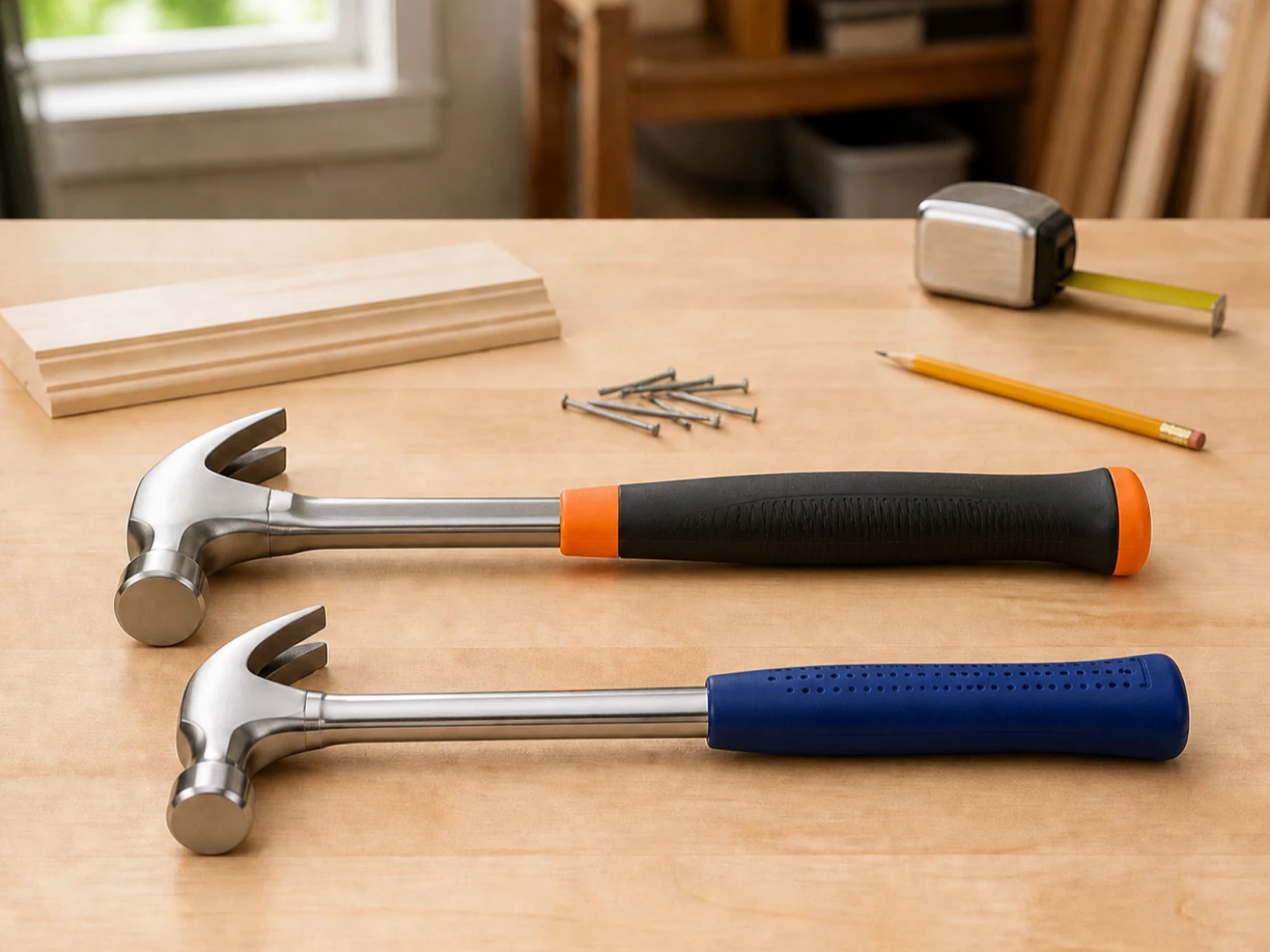
Two unbranded 16-ounce curved claw hammers with black-orange and blue handles on a maple workbench with trim, nails, pencil, and tape measure for the Fiskars IsoCore 16 oz vs Estwing E3-16C comparison.
The short answer

Which one should most people buy?

For a home tool kit, the better default is the one with the clearer all-around precision-and-pulling brief.

The Fiskars IsoCore 16 oz Finishing Hammer is the more versatile default for a household tool drawer or a small finish-work kit. Fiskars specifies a 16-ounce head, a 13.5-inch overall length, a rip claw for pulling nails, and a performance handle intended to stay secure whether you choke up for a precise strike or swing more fully. Those are practical details for the buyer who will use one hammer across trim touchups, cabinet hardware, hanging projects, and routine repairs.

The handle is the other deciding point. Fiskars describes its patented IsoCore Shock Control System as absorbing strike shock and vibration, with a dual-layer handle capturing lingering vibration. This is not a promise that every task will feel the same, but it is a published design focus that suits a general-purpose hammer used over varied small jobs. The Estwing is still a strong, straightforward alternative: its official page lists solid American steel, a fully polished smooth face, a Blue Shock Reduction Grip, and a head and handle forged in one piece.

Pick the Estwing E3-16C if that one-piece, 13-inch steel format is exactly what you want. It has the same listed 16-ounce head weight and a curved claw, so it is not a lesser tool; it is the more traditional choice. For most buyers, though, the Fiskars pairing of a slightly longer 13.5-inch layout, rip claw, and explicitly precision-friendly handle gives it the clearer reason to be the hammer that stays nearest the workbench.
At a glance

The key specs.

Manufacturer-published details, kept separate from assumptions about a particular project.

Versatile finishing layout

Fiskars IsoCore 16 oz

  • Model750200-1002, 16 oz Finishing Hammer
  • Head & length16 oz; 13.5 in.
  • Claw & faceRip claw; finishing-hammer layout
  • Controls & fitIsoCore Shock Control System; dual-layer performance handle
  • Main drawbackNot the shorter one-piece steel format
  • Buyer-fit summaryFor mixed home repairs and detail work with a rip claw
View Fiskars on Amazon
Classic forged steel

Estwing E3-16C

  • ModelE3-16C Curved Claw Hammer
  • Head & length16 oz / 448 g; 13 in. / 330 mm
  • Claw & faceCurved claw; smooth face
  • Controls & fitSolid American steel; Blue Shock Reduction Grip
  • Main drawbackLess explicitly aimed at choke-up detail work
  • Buyer-fit summaryFor a shorter, traditional one-piece steel hammer
View Estwing on Amazon
Fit check

Choose by routine, not tool snobbery.

These are close in head weight. Decide how you reach for, swing, and store the hammer.

Buy the Fiskars if

You want one 16-ounce hammer that puts detail work and ordinary nail pulling in the same brief. Fiskars explicitly calls out trim, cabinets, detail work, a rip claw, and a handle shape that works when you choke up for precision. Its 13.5-inch listed length gives it a little more reach than the Estwing without changing the basic compact-hammer category.

Skip it if: Your preference is a traditional, shorter, polished, one-piece steel hammer with a curved claw and smooth face. Those are the Estwing E3-16C’s published calling cards.

Buy the Estwing if

You value a very direct forged-steel design. Estwing lists solid American steel, a fully polished head and handle forged in one piece, a smooth face, curved claw, and Blue Shock Reduction Grip. At 13 inches, it is the slightly shorter option for a buyer who wants that familiar curved-claw format in a simple workbench tool.

Skip it if: You want the manufacturer to specifically frame the handle around precision choke-up use and the claw around quick nail pulling. Fiskars makes those parts of its stated product design.

Quick fit check: Picture the next five jobs, not the most dramatic one. If they include trim, mounting, and touchups, favor Fiskars. If they call for a compact traditional steel hammer you already know you like, favor Estwing.
Side by side

Compare the trade-offs.

Concrete manufacturer details first; no live prices, review scores, or invented performance claims.

MetricFiskars IsoCore 16 ozEstwing E3-16C
Best fitMixed detail work and nail pullingTraditional forged-steel curved-claw routine
Model750200-1002 Finishing HammerE3-16C Curved Claw Hammer
Head weight16 oz16 oz / 448 g
Overall length13.5 in.13 in. / 330 mm
Claw & faceRip claw; finishing-hammer layoutCurved claw; smooth face
Handle approachIsoCore system and dual-layer performance handleBlue Shock Reduction Grip
Construction wordingShock-control system for strike shock and vibrationSolid American steel, forged in one piece
Buyer fit summaryOne adaptable hammer for household finishing tasksShorter classic steel hammer with a curved claw
How we reasoned

The criteria behind the pick.

This comparison begins with what is genuinely alike. Both models have a published 16-ounce head weight, so choosing a winner by pretending one is a substantially heavier striking tool would not help a buyer. We weighted the factors that actually separate them: listed overall length, claw description, face description, handle design, and construction wording.

Fiskars wins because its published design speaks more directly to the varied routine that makes up most home ownership and small repair work. The official description ties its 16-ounce finishing hammer to trim, cabinet mounting, and detail work. It also names a rip claw, precision choke-up use, fuller swings, IsoCore shock control, and a dual-layer handle. That is a coherent set of features for a person who wants one familiar hammer rather than a specialized collection.

Estwing’s advantage is real, not a footnote. Its E3-16C is 13 inches long, compared with Fiskars’s 13.5 inches, and its official product page describes a smooth face, curved claw, solid American steel, fully polished surfaces, and a head and handle forged in one piece. A buyer who likes the balance and directness of that classic construction has a valid reason to choose it. The difference is not that Estwing lacks vibration-focused grip design; Estwing lists a Blue Shock Reduction Grip. The difference is the overall format and intended routine.

We did not turn any manufacturer claim into a promise about a particular board, nail, swing force, or result. Material, fasteners, user technique, and job conditions matter. Length and head weight also tell only part of the story about feel. The recommendation simply gives the Fiskars the edge for buyers who want published detail-work cues and a rip-claw layout, while preserving the Estwing as the better match for a shorter one-piece steel preference.

That distinction avoids the usual overbuilt-tool trap. A basic tool purchase should solve the repeated work on hand: hanging, securing, tapping, pulling, and putting the tool away. Fiskars offers a more explicitly flexible set of published cues for that broad list. Estwing makes the more traditional choice easy to recognize. Decide which description resembles your workbench before treating either as a universal answer.

Source trail

What the recommendation is based on.

Fiskars IsoCore 16 oz

Fiskars’s official product listing identifies the 750200-1002 as a 16-ounce, 13.5-inch finishing hammer. It describes the IsoCore Shock Control System, dual-layer handle, rip claw, precision choke-up design, and uses including trim and cabinet work. Those details establish its adaptable finishing-work angle.

Read the official Fiskars product page

Estwing E3-16C

Estwing’s official E3-16C page lists solid American steel, a smooth face, Blue Shock Reduction Grip, 16-ounce / 448-gram head weight, and 13-inch / 330-millimeter length. It also describes the polished head and handle as forged in one piece. Those details establish its compact forged-steel angle.

Read the official Estwing product page

Method note: This page uses manufacturers’ published product details and Amazon product identifiers for the linked models. It does not use live pricing, review scores, performance testing, or a fit guarantee. Confirm the exact model, finish, availability, included pieces, and manufacturer instructions before checkout or use.
Before checkout

Questions before checkout.

Answers match the FAQ structured data on this page.

Which curved claw hammer is the better pick for most people?

The Fiskars IsoCore 16 oz Finishing Hammer is the better pick for most people choosing between these two 16-ounce curved claw hammers. Fiskars lists a 13.5-inch length, a rip claw, a patented IsoCore Shock Control System, and a performance handle made for both precision strikes and fuller swings. Choose the Estwing E3-16C when a 13-inch forged one-piece steel hammer with its Blue Shock Reduction Grip is the simpler fit for your tool kit.

Are these both 16-ounce curved claw hammers?

Yes. Fiskars identifies its model as a 16 oz, 13.5-inch finishing hammer with a rip claw. Estwing lists the E3-16C as a 16 oz / 448 g curved claw hammer with a smooth face. They occupy the same general household and finish-work category, but their claw wording and handle construction differ.

Which hammer is longer?

Fiskars lists the IsoCore Finishing Hammer at 13.5 inches. Estwing lists the E3-16C at 13 inches / 330 mm. The published difference is half an inch. That measurement helps compare storage and reach, but it does not by itself guarantee a particular swing feel or job result.

Do both hammers address vibration?

Yes, with different manufacturer wording. Fiskars describes its patented IsoCore Shock Control System and dual-layer handle as reducing strike shock and lingering vibration. Estwing lists a Blue Shock Reduction Grip and says its molded grip reduces vibrations caused by impact. Neither statement substitutes for trying a tool in hand or following safe-use instructions.

When should I choose the Estwing E3-16C instead?

Choose the Estwing E3-16C if you specifically want its 13-inch solid American steel, fully polished one-piece construction, smooth face, curved claw, and Blue Shock Reduction Grip. It is the direct alternative for a buyer who wants the shorter, traditional forged-steel format rather than Fiskars’s 13.5-inch rip-claw finishing-hammer layout.

Do these specifications promise a particular nail-pulling or driving result?

No. Published head weight, length, claw style, and handle features help compare the models, but they do not guarantee performance on a particular material or project. Confirm the exact model and manufacturer instructions, and use appropriate safety practices for the task.

Cuisinart CCG-216ABest portable charcoal grill pick
Amazon