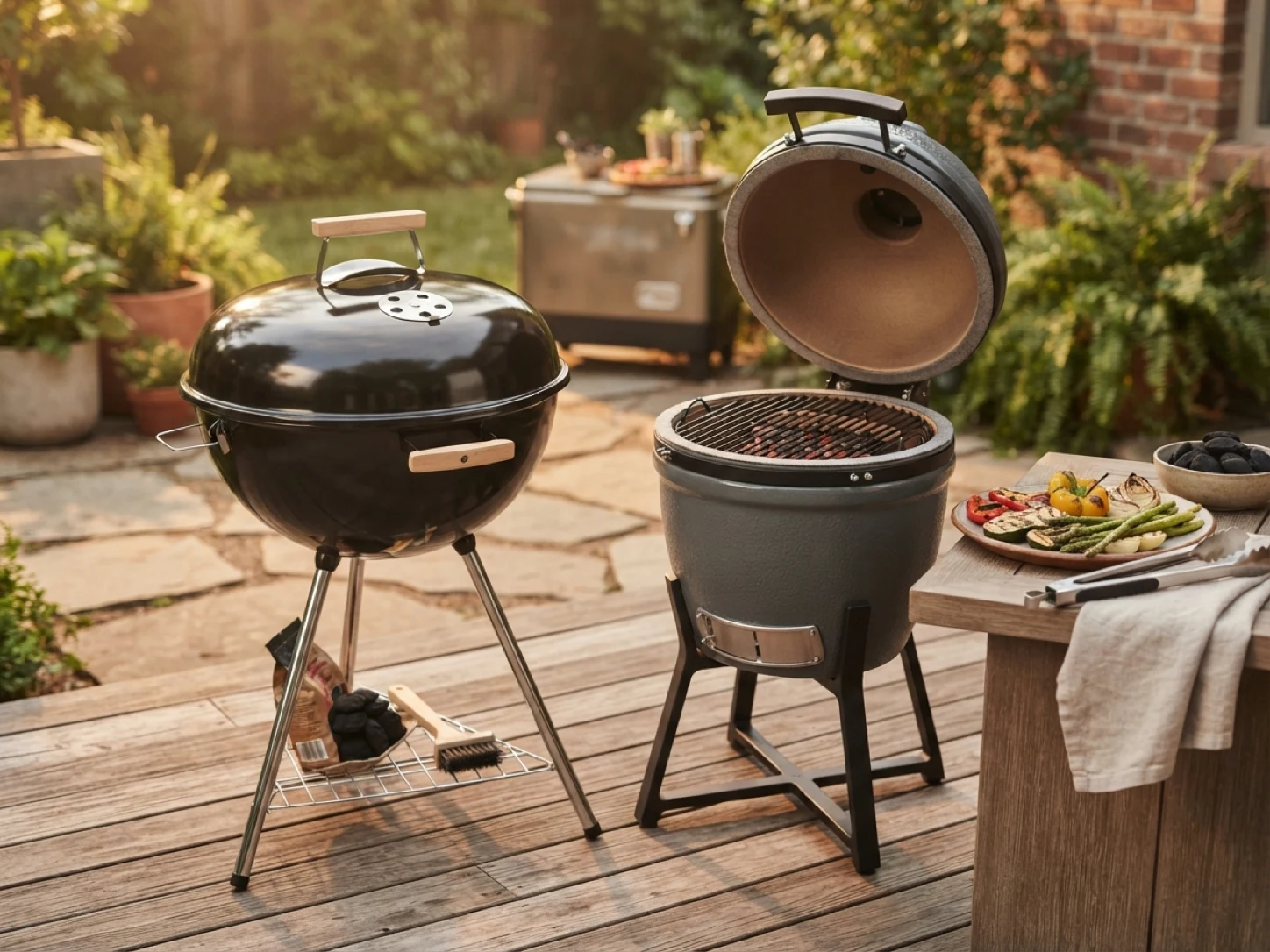
Weber wins on practical grate space and simple transport; Char-Griller wins when the cook is built around controlled heat.
These are genuinely comparable because both are compact charcoal grills meant to leave a large permanent grill behind. Both have a covered fire, a lid, a grate, a dedicated ash-management feature, and carry-minded design. But they ask for different routines. The Weber is an 18-inch portable kettle: open it, arrange charcoal, grill, use the lid and dampers as needed, empty the catcher once cool, and lock the lid for the trip home. The AKORN Jr. is a compact kamado-style unit, built around insulation and adjustable airflow rather than an open kettle format.
For most shoppers, the Weber is the more useful default. Weber publishes 240 square inches of primary and total cooking area, compared with Char-Griller’s listed 155 square inches. That difference matters when a small patio cookout turns from a few burgers into a mixed grate of vegetables, chicken, and buns. Weber also lists a 19.7-inch-high by 19.7-inch-wide by 20.5-inch-deep lid-closed footprint, an 18-inch diameter, plated-steel grate, two rust-resistant aluminum dampers, ash catcher, and a lid lock that doubles as a lid holder. It is specific, legible, and suited to the common task: make charcoal grilling portable without adding a second hobby.
The AKORN Jr. is the right alternative when the reason to shop is not extra grate area but thermal behavior. Char-Griller lists a 200–700°F range, triple-walled insulation, dual adjustable dampers, a cast-iron grate, an EasyDump ash pan, and 155 square inches of cooking space. The maker frames it for both high-heat searing and lower-temperature smoking. That is a meaningful trade-off, not a minor feature advantage. Buy the Weber unless you will actually use the AKORN Jr.’s insulated, damper-managed format often enough to make its smaller cooking area and 35.7-pound published weight worthwhile.