Head-to-head hybrid podcast microphone comparison

Shure MV7+ vs RODE PodMic USB

The Shure MV7+ is the better hybrid USB/XLR podcast microphone for most solo creators because it is lighter, has automatic USB processing, touch mute, a customizable LED panel, 3.5 mm monitoring, and app controls that make quick desk recording easier. The RODE PodMic USB is the stronger alternative if you want a heavier broadcast-style body, integrated swing mount, included external pop filter, and RODE's APHEX processing workflow.

As an Amazon Associate, Worth Adding earns from qualifying purchases. We may earn a commission if you buy through our links.

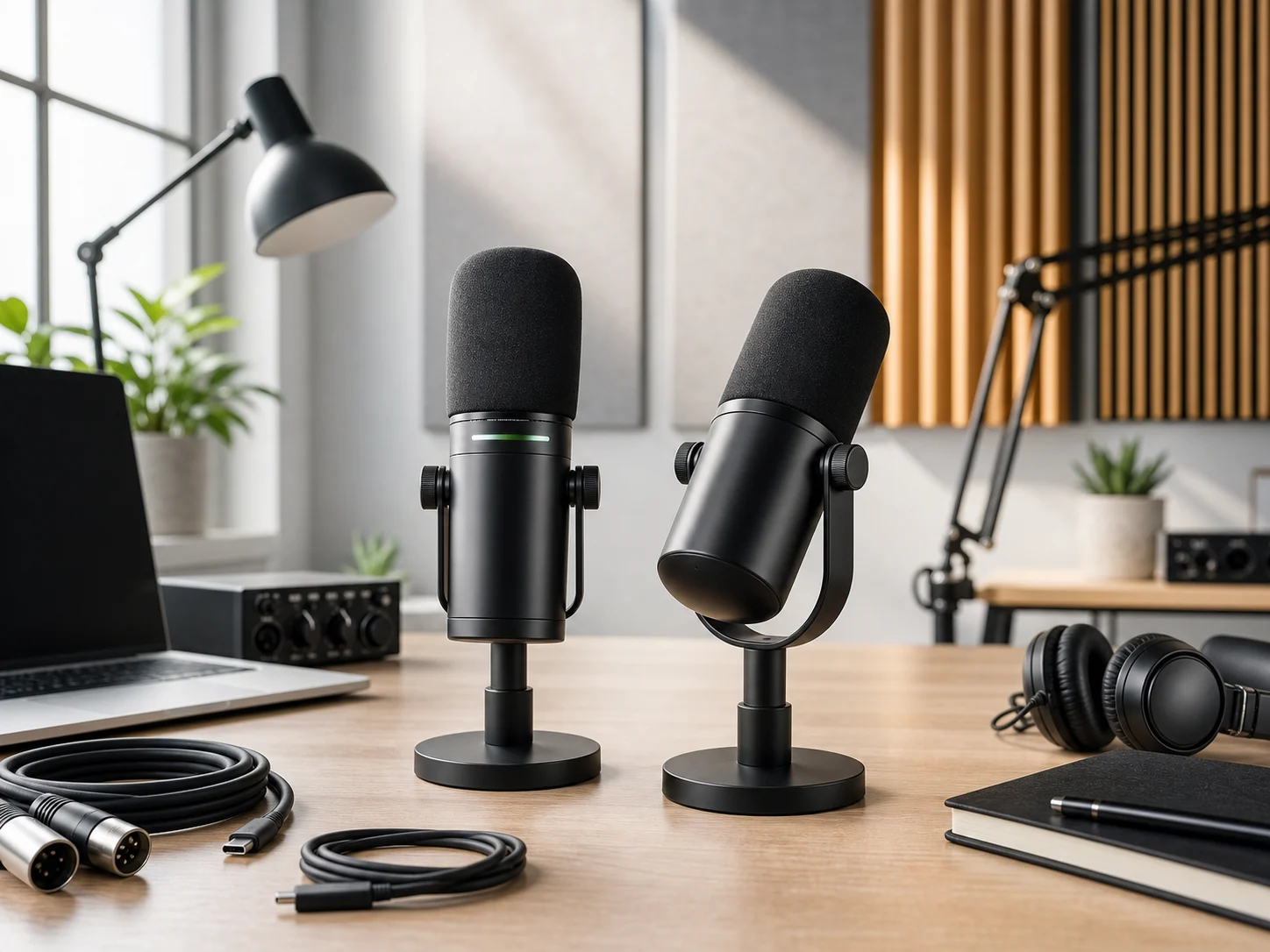
Two unbranded black broadcast-style podcast microphones on a bright home recording desk with a laptop, audio interface, headphones, USB-C cable, XLR cable, boom arm, acoustic panels, and notebook for the Shure MV7+ vs RODE PodMic USB comparison
Last checked
Winner Shure MV7+
Studio-style option RODE PodMic USB
Verdict

Which one should most people buy?

Choose the Shure if you want a lighter all-in-one creator mic that can clean up a USB workflow quickly. Choose the RODE if your desk already has a sturdy arm and you prefer a heavier broadcast shell, included external pop filter, and RODE software ecosystem.

Buy the MV7+ unless RODE's heavier studio-style setup is the point.

The MV7+ wins for most desks because its official feature set is built around reducing setup friction: USB-C recording, XLR expansion, automatic level handling, noise reduction, plosive control, touch mute, and software control without needing to build a full studio chain first.

The PodMic USB is still a serious choice. RODE lists a dynamic cardioid design, XLR and USB-C connectivity, 3.5 mm monitoring, 24-bit/48 kHz digital audio, APHEX processing, internal shock mount, internal pop filter, external pop filter, and a rugged 900 g body. That works best when you already want a heavier arm-mounted broadcast mic.

At a glance

The key specs.

Best for most creators

Shure MV7+

A lighter hybrid USB/XLR dynamic microphone for podcasters, streamers, and voice creators who want app-guided USB processing now and an XLR path later.

Mic type
Dynamic moving-coil, cardioid
Connectivity
USB-C, XLR, and 3.5 mm headphone monitoring
Digital audio
16- or 24-bit, 48 kHz listed by Shure
Frequency response
50 Hz to 16,000 Hz
USB-C max SPL
128 dB SPL
Weight
573.5 g / 1.26 lb
Best for
Solo podcasting, streaming, voiceover, desk recording, auto-level help, touch mute, and lighter boom-arm setups.
Studio-style alternative

RODE PodMic USB

A heavier broadcast-style dynamic microphone for shoppers who want XLR/USB flexibility, RODE APHEX processing, a swing mount, and an included external pop filter.

Mic type
Dynamic, cardioid, end-address
Connectivity
USB-C, XLR, and 3.5 mm headphone monitoring
Digital audio
24-bit, 48 kHz listed by RODE
Frequency range
20 Hz to 20 kHz
Maximum SPL
148 dB SPL
Weight
900 g
Best for
Sturdy boom arms, RODE Central or RODE Connect workflows, close voice work, and shoppers who want an included pop filter.
Buyer guide

Choose by recording setup.

Both microphones are dynamic, cardioid, USB-C/XLR hybrids with headphone monitoring. The real decision is how much you value automatic Shure cleanup, RODE's APHEX workflow, physical weight, included mounting hardware, and future XLR use.

Shure MV7+

Buy this if / skip this if

Buy this if
  • You want a lighter hybrid mic that is easier for many desk arms than a 900 g broadcast body.
  • You record solo voice and want Auto-Level Mode, real-time denoiser, Digital Popper Stopper, tone shaping, and touch mute in the USB workflow.
  • You want USB-C simplicity now but still want XLR available for an audio interface, mixer, or future studio setup.
Skip this if
  • You prefer RODE Central, RODE Connect, UNIFY, or APHEX processing because that is already your software setup.
  • You want the included external pop filter and integrated swing mount that RODE bundles with the PodMic USB.
  • You care more about a heavier all-metal broadcast body than keeping boom-arm load low.
RODE PodMic USB

Buy this if / skip this if

Buy this if
  • You have a sturdy boom arm or stand and want the PodMic USB's 900 g studio-style feel and integrated swing mount.
  • You want RODE's APHEX tools, including high-pass filter, compressor, noise gate, Aural Exciter, and Big Bottom through supported apps.
  • You value the included external pop filter, internal shock mount, internal pop filter, and close-address broadcast workflow.
Skip this if
  • Your boom arm is lightweight or already struggles with heavier microphones.
  • You want Shure's Auto-Level Mode and denoiser specifically rather than RODE's more studio-style processing controls.
  • You want a lighter mic for moving between desks, travel kits, or temporary recording setups.
USB processing

Both mics can record over USB, but their processing philosophies differ. Shure leans toward automatic level, denoise, and plosive help; RODE leans toward APHEX-style tools you shape through its apps.

XLR path

XLR lets either mic grow into an interface or mixer setup, but software processing may not carry over the same way. If XLR is your endgame, plan gain staging and processing outside the mic too.

Mount load

The Shure's 573.5 g body is easier for many desk arms. The RODE's 900 g weight can feel stable and premium, but it raises the bar for the stand or boom arm you pair with it.

Before you buy

Check these podcast mic fit points first.

  • Confirm your stand or boom arm can hold the microphone weight plus cable tension without sagging.
  • Plan for close placement. Dynamic broadcast mics work best near the mouth, so desk layout matters more than spec sheets imply.
  • Decide whether you will record through USB or XLR most days. USB gives built-in app processing; XLR shifts more work to your interface, mixer, or software chain.
  • Budget for the missing setup pieces: arm, stand, shock isolation, pop filter, XLR cable, USB adapter, or headphones if they are not already in your kit.
Side by side

Compare the trade-offs.

The table focuses on official specs and setup choices that change daily recording: connectivity, digital audio, onboard processing, monitoring, physical weight, mounting, and who each mic fits best.

Shure MV7+ vs RODE PodMic USB official spec comparison.
Metric Shure MV7+ RODE PodMic USB
Best fit WinnerSolo creators who want a lighter hybrid mic with automatic USB cleanup, touch mute, LED feedback, and an easy path from USB to XLR. Creators with a sturdier stand who want a heavier broadcast body, RODE APHEX processing, integrated swing mount, and included external pop filter.
Microphone type Dynamic moving-coil; unidirectional cardioid Dynamic; cardioid; end-address
Connections USB-C, XLR, and 3.5 mm headphone output USB-C, XLR, and 3.5 mm headphone output with volume control
Digital audio 16- or 24-bit, 48 kHz listed by Shure 24-bit, 48 kHz listed by RODE
Frequency spec 50 Hz to 16,000 Hz frequency response 20 Hz to 20 kHz frequency range
Maximum SPL 128 dB SPL over USB-C 148 dB SPL
Onboard processing Auto-Level Mode, Digital Popper Stopper, real-time denoiser, tone slider, reverb, compressor, limiter, and high-pass filter listed by Shure APHEX processing, including compressor, noise gate, high-pass filter, Aural Exciter, and Big Bottom listed by RODE
Mounting and physical setup Adjustable yoke, 5/8 in-27 thread mount, diecast aluminum housing, 573.5 g weight Integrated swing mount with 5/8-inch and 3/8-inch threads, all-metal construction, 900 g weight
Included setup pieces Foam windscreen and 3 m USB-C to USB-C cable listed by Shure SC29 USB-C cable, external pop filter, internal pop filter, and internal shock mount listed by RODE materials
Main drawback Its strongest processing advantages are tied to the USB/app workflow, and the official frequency response is narrower than the RODE spec. It is much heavier, needs a sturdier mount, and its software tools are best if you are comfortable with the RODE app ecosystem.
Buyer fit summary The MV7+ is the easier all-in-one creator pick. The PodMic USB is the heavier studio-style alternative.
How we compared

The criteria behind the pick.

We compared manufacturer-published product pages, user guides, and datasheets, then weighted the differences that affect a buyer's desk: USB and XLR workflow, monitoring, onboard processing, mounting, weight, included accessories, app dependency, and setup flexibility. Prices, ratings, review counts, coupons, and availability were intentionally left out because they can change and were not needed for this decision.

Specs checked

Connectivity, mic type, polar pattern, frequency spec, digital conversion, max SPL, monitoring, onboard processing, dimensions or weight, mounting, accessories, and official setup guidance were used.

Fit checked

The recommendation favors the microphone that solves the most common solo creator setup problems without requiring a heavy stand, a full XLR chain, or a separate processing workflow on day one.

Best fit

Pick Shure for a lower-friction solo desk setup. Pick RODE for a sturdier broadcast-style rig and RODE APHEX software workflow.

Source trail

What the recommendation is based on.

FAQ

Questions before checkout.

Which microphone is better for most podcasters?

The Shure MV7+ is the better default for most solo podcasters, streamers, and voice creators who want a hybrid USB/XLR dynamic microphone with automatic USB processing, a lighter body, touch mute, and app-controlled cleanup. The RODE PodMic USB is better if you specifically want the heavier broadcast body, integrated swing mount, included external pop filter, and RODE APHEX processing workflow.

Do both microphones work over USB and XLR?

Yes. Shure lists USB-C and XLR outputs for the MV7+, and RODE lists analog XLR plus digital USB-C for the PodMic USB. With both microphones, software processing is mainly part of the USB workflow, so check the manufacturer guidance if you plan to use XLR into an interface.

Which one is easier to mount on a boom arm?

The Shure MV7+ is lighter at 573.5 g, which is easier for many desk arms. The RODE PodMic USB is heavier at 900 g and has an integrated swing mount, so it can feel more studio-like but needs a sturdier arm or stand.

Is the RODE PodMic USB still worth buying?

Yes, if you want RODE's heavier broadcast-style body, integrated swing mount, included external pop filter, and APHEX processing through supported RODE apps. It is less convenient if your setup needs a lighter microphone or you prefer Shure's automatic cleanup tools.

Did this comparison use prices or customer ratings?

No. Prices, coupons, ratings, review counts, and availability were left out because they can change quickly and were not needed for this official-spec buying decision.

Best for most

Shure MV7+

The lighter body, USB-C/XLR flexibility, touch mute, headphone monitoring, Auto-Level Mode, denoiser, plosive control, and app-friendly setup make the MV7+ the better default podcast microphone for most solo desks.

Last checked: . Retailer availability, coupons, delivery estimates, and other listing details can change without notice.

Decision notes
Best for mostShure MV7+
Studio-style optionRODE PodMic USB
Data sourceOfficial manufacturer pages, user guides, datasheet, and product-specific Amazon listings
Last checked
Shure MV7+ Better creator setup.
Amazon