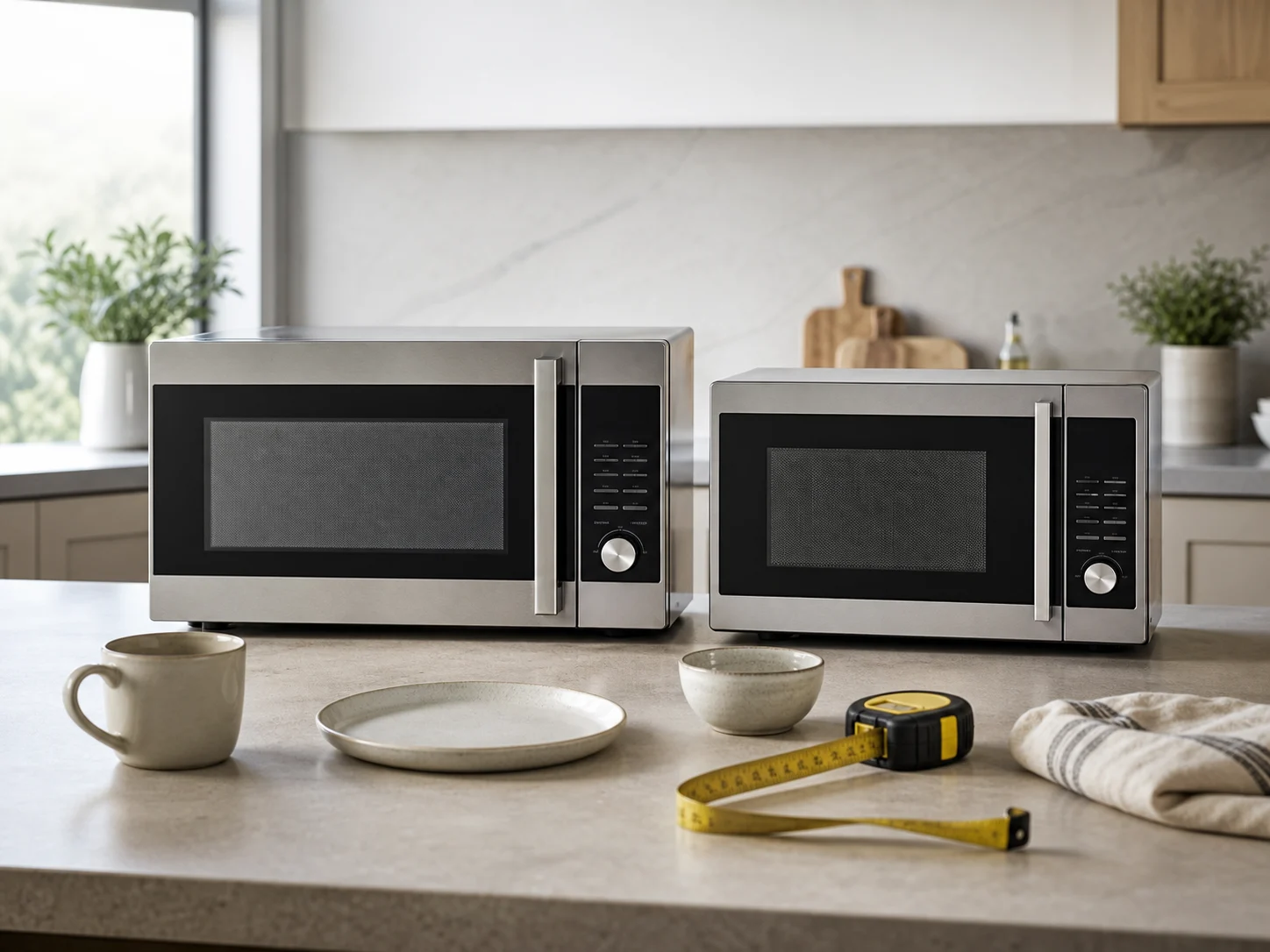
Head-to-head countertop microwave comparison

Panasonic NN-SN686S vs Toshiba EM131A5C-BS

The Panasonic NN-SN686S is the stronger default if you care about faster cooking, inverter-style power control, and gentler defrosting. The Toshiba EM131A5C-BS still makes sense if you prefer a handle door, a larger listed turntable, mute mode, and simpler sensor presets.

As an Amazon Associate, Worth Adding earns from qualifying purchases. We may earn a commission if you buy through our links.

Two unbranded countertop microwave ovens on a bright kitchen counter with a dinner plate, mug, bowl, measuring tape, and folded towel for the Panasonic NN-SN686S vs Toshiba EM131A5C-BS comparison
Last checked
Winner Panasonic NN-SN686S
Best handle-door pick Toshiba EM131A5C-BS
Verdict

Which one should most people buy?

Both are 1.2-cubic-foot countertop microwaves, but they are not the same kind of appliance decision. Panasonic leans into cooking control; Toshiba leans into familiar controls, a handle, and convenience modes.

Panasonic NN-SN686S is the better everyday cooking pick.

The Panasonic wins because its 1200-watt output and inverter approach give it the stronger cooking-control story for reheating leftovers, softening ingredients, and defrosting without relying only on full-power bursts. That matters more over years of daily use than one extra shortcut label.

Choose the Toshiba EM131A5C-BS if your kitchen routine values a pull handle, smart-sensor menus, a larger listed glass turntable, mute mode, and ECO mode more than Panasonic's inverter-focused cooking control.

At a glance

The Key Specs

Best cooking-control pick

Panasonic NN-SN686S Genius Sensor Inverter Microwave

The NN-SN686S is a 1.2-cubic-foot countertop microwave with 1200 watts of cooking power, Panasonic inverter cooking, Genius Sensor controls, Turbo Defrost, and a 13.4-inch turntable.

Model
NN-SN686S
Capacity
1.2 cu ft
Cooking power
1200 watts
Turntable
13.4 in glass turntable
Best for
Daily reheating, defrosting, and shoppers who want inverter-style power control.
Best handle-door alternative

Toshiba EM131A5C-BS Smart Sensor Microwave

The EM131A5C-BS is a 1.2-cubic-foot countertop microwave with 1100 watts of cooking power, smart-sensor menus, ten power levels, a 12.4-inch turntable, mute mode, and ECO mode.

Model
EM131A5C-BS
Capacity
1.2 cu ft
Cooking power
1100 watts
Turntable
12.4 in glass turntable
Best for
Shoppers who prefer a handle door, sensor menus, mute mode, and simple family reheating.
Buyer guide

Choose by cooking behavior first.

A countertop microwave is an everyday appliance. The right pick depends less on a spec-sheet win and more on how you reheat plates, defrost ingredients, and interact with the door and controls.

Panasonic NN-SN686S

Buy this if / skip this if

Buy this if
  • You reheat uneven leftovers and want inverter-style power control instead of only pulsed full-power cycling.
  • You value the higher 1200-watt output for faster heating in a 1.2-cubic-foot countertop size.
  • You defrost meat, soup, sauce, or dense frozen portions often enough for Turbo Defrost to matter.
Skip this if
  • You strongly prefer a pull handle instead of a push-button door release.
  • You want mute and ECO modes called out as part of the everyday control set.
  • You mostly run simple one-touch reheats and do not care about inverter-style cooking behavior.
Toshiba EM131A5C-BS

Buy this if / skip this if

Buy this if
  • You want a familiar handle-door microwave with sensor menus and ten power levels.
  • You care about quiet kitchen use and want a mute function for beeps.
  • You like the convenience of ECO mode and straightforward one-touch family reheating.
Skip this if
  • You want the higher 1200-watt output of the Panasonic.
  • You specifically want inverter heating for gentler defrosting and reheating.
  • Your counter depth is tight and every inch behind the door swing matters.
Wattage affects speed

The Panasonic's 1200-watt rating gives it more heating headroom than the Toshiba's 1100-watt rating. In practice, that matters most for dense leftovers, large bowls, and repeated daily use.

Inverter changes power delivery

Inverter-style control is useful when you want gentler cooking or defrosting. If your microwave mostly heats mugs and popcorn, the benefit may be less visible.

Door style is not trivial

A handle can feel better when hands are full or the microwave sits below eye level. A push-button door can still be fine, but it is worth choosing deliberately.

Before you buy

Measure the counter like the door is open.

  • Check counter depth, side clearance, rear clearance, and nearby cabinet pulls before ordering.
  • Measure the plates and bowls you actually reheat against the listed turntable diameter.
  • Use a grounded outlet with enough room for the plug and cord path behind the microwave.
  • Do not treat sensor menus as automatic perfection; covered foods, container shape, and starting temperature still affect results.
Side by side

Compare the trade-offs.

Panasonic is the cooking-control pick. Toshiba is the handle-door and simple-sensor alternative.

Key buying trade-offs for Panasonic NN-SN686S and Toshiba EM131A5C-BS, based on manufacturer and retailer product information checked June 17, 2026.
Metric Panasonic NN-SN686S Toshiba EM131A5C-BS
Best fit Winner Faster everyday cooking, inverter-style power delivery, and frequent defrosting. Handle-door shoppers, sensor menus, mute mode, ECO mode, and simple family reheating.
Capacity 1.2 cu ft. 1.2 cu ft.
Cooking power Advantage 1200 watts. 1100 watts.
Heating approach Advantage Panasonic inverter cooking, Genius Sensor, and Turbo Defrost. Smart Sensor menus, ten power levels, and one-touch controls.
Turntable 13.4 in glass turntable. 12.4 in glass turntable.
Door and controls Push-button door release and sensor-focused controls. Advantage Pull handle, mute function, ECO mode, and smart-sensor buttons.
Main drawback Push-button door and fewer quiet-mode convenience cues. Lower wattage and no inverter-style heating claim.
How we compared

The criteria behind the pick.

We focused on specs that change daily ownership: cooking power, heat-control approach, turntable size, door style, sensor controls, counter fit, and noise-related convenience settings.

Cooking control

We gave extra weight to wattage, inverter-style power delivery, sensor cooking, and defrost behavior because those details affect how often leftovers dry out or frozen food stays cold in the middle.

Physical fit

We compared capacity and turntable diameter, then treated door style and counter depth as ownership details rather than afterthoughts.

Convenience without live claims

We did not use live pricing, ratings, review counts, coupons, or availability. The recommendation is based on stable model features and shopper fit.

Source trail

What the recommendation is based on.

Specs were checked against manufacturer model information and product-specific retailer pages. Prices, ratings, review counts, coupons, and live availability were intentionally left out.

Panasonic NN-SN686S

Model-specific specs used for capacity, cooking power, inverter feature set, Genius Sensor cooking, Turbo Defrost, and turntable size.

Sources: Panasonic model search and Amazon product page.

Toshiba EM131A5C-BS

Model-specific specs used for capacity, cooking power, smart-sensor menus, power levels, turntable size, mute mode, ECO mode, and handle-door design.

Sources: Toshiba model search and Amazon product page.

FAQ

Questions before checkout.

The right microwave is mostly about reheating behavior, door style, counter fit, and whether inverter control is worth prioritizing.

Which countertop microwave is better for most kitchens?

Panasonic NN-SN686S is the stronger default if you want 1200 watts, inverter-style power delivery, Genius Sensor cooking, and a compact 1.2-cubic-foot footprint for everyday reheating and defrosting.

Who should buy the Toshiba EM131A5C-BS?

Choose the Toshiba if you want a 1.2-cubic-foot microwave with 1100 watts, a handle door, mute mode, ECO mode, and straightforward smart-sensor menus.

Does inverter heating matter?

It can. Panasonic uses inverter power control to avoid relying only on full-power pulses, which is useful for gentler reheating, defrosting, and foods that dry out easily.

Are these built-in microwaves?

No. Both are countertop microwaves. Measure counter depth, side and rear clearance, door swing, and access to a grounded outlet before buying.

Should I choose based only on wattage?

No. Wattage matters for speed, but turntable size, controls, sensor behavior, exterior dimensions, and how you reheat food day to day matter just as much.

Panasonic NN-SN686S Best cooking-control pick
Amazon