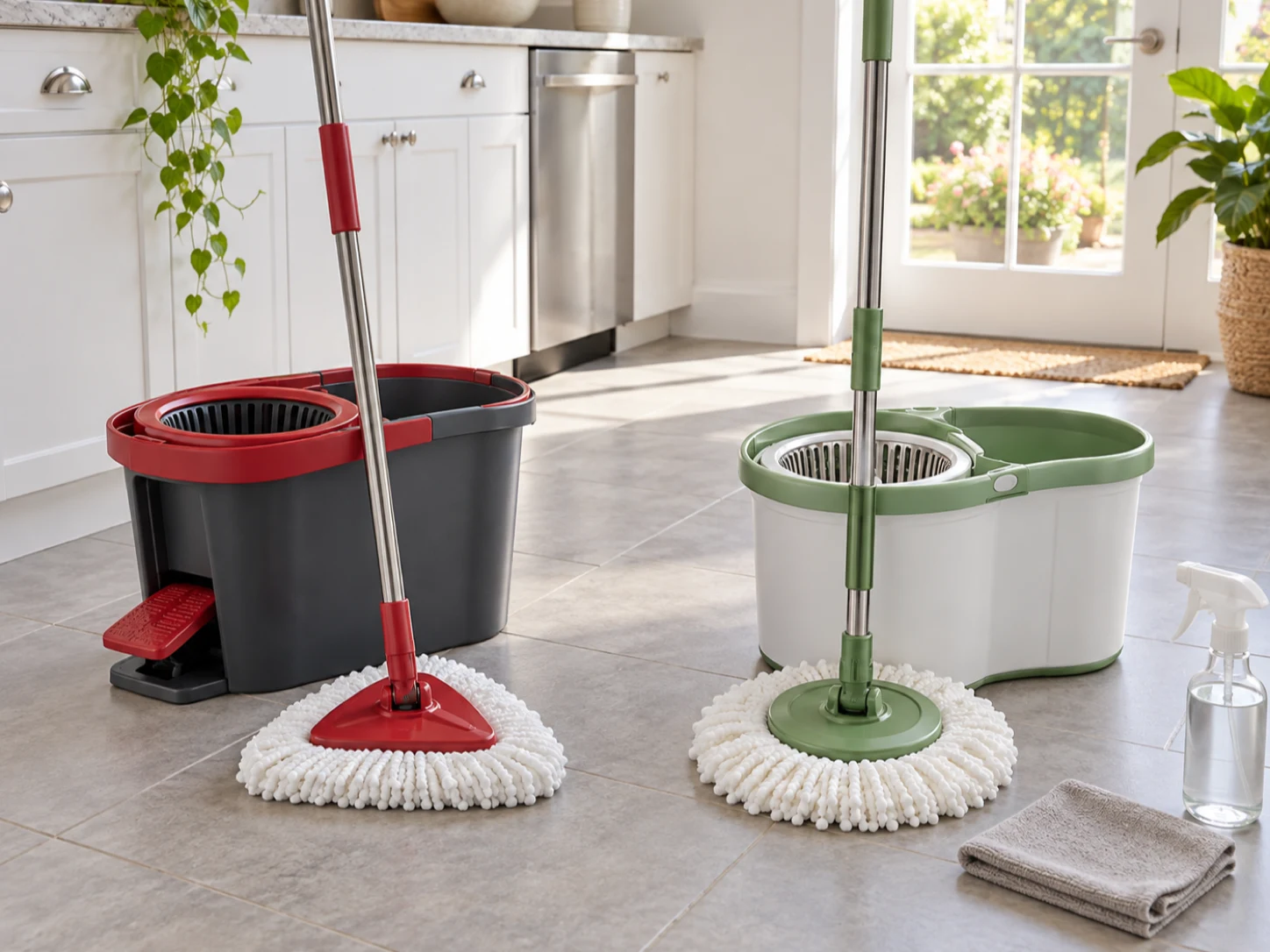
The O-Cedar EasyWring is the better default for most households comparing these two spin mop systems. Its official page identifies the things a buyer can actually use to choose: a foot-activated pedal for hands-free wringing and controlled water release, a triangular microfiber head, a telescopic handle that adjusts to 4.25 feet (51 inches), and an integrated C-Clip that holds the handle when stored. Those details make a coherent routine: set the desired moisture with a pedal, use the pointed head around room edges, then clip the handle up instead of leaning the kit against a wall.
The Libman Tornado remains a legitimate alternative, not a consolation prize. Libman describes a large machine-washable microfiber head, a heavy-duty bucket and spinning chamber, an impact-resistant lower handle, and a push-down wringing routine: unlock the handle, press once for a damp mop, or press more for a drier one. That direct handle-operated system may be exactly what a shopper wants, particularly if the replaceable #1284 head and a large round head are the useful details for their rooms.
This verdict deliberately avoids a live-price comparison, retailer scores, and promises about cleaning outcomes. The right choice depends on the exact bundle, floor material, cleaning solution, storage space, and the motion you find easier to repeat. For the ordinary buyer who wants the clearest control layout and an explicitly triangular corner-oriented head, EasyWring has the stronger evidence-led case.