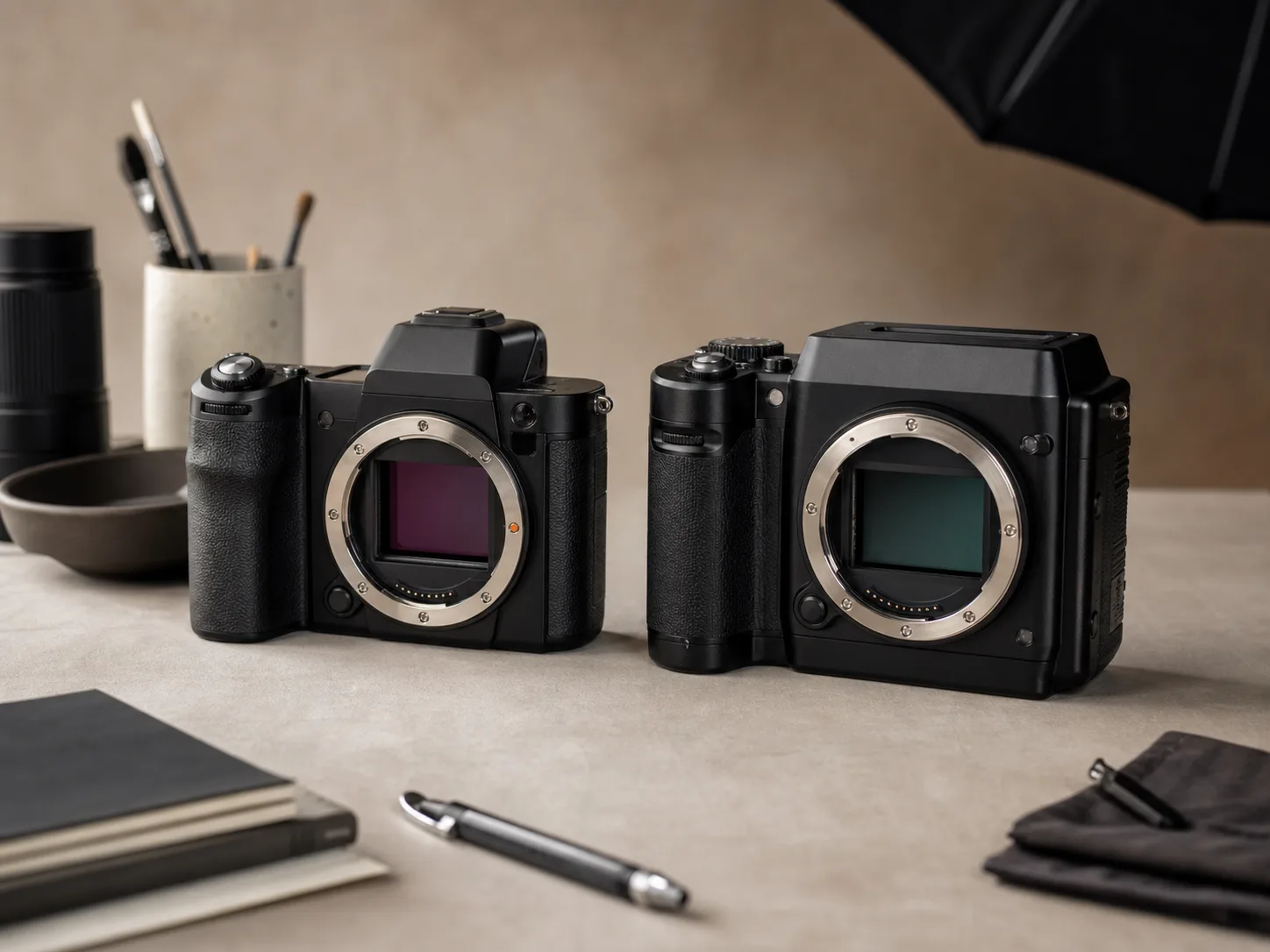
Head-to-head medium format camera comparison

GFX100 II vs GFX100S II

GFX100 II and GFX100S II share Fujifilm's 102MP large-format look, 8.0-stop in-body stabilization, X-Processor 5, and G mount lenses. The split is practical: GFX100 II is the pro hybrid body with the better EVF, faster media, stronger burst depth, 8K video, and more controls; GFX100S II is the lighter stills-first body that keeps the sensor quality easier to carry.

As an Amazon Associate, Worth Adding earns from qualifying purchases. We may earn a commission if you buy through our links.

Two unbranded medium format mirrorless camera bodies on a studio table under soft photography lighting
Last checked
Winner Fujifilm GFX100 II
Best alternative Fujifilm GFX100S II
Verdict

Which one should most people buy?

Choose GFX100 II if one camera has to cover commercial stills, faster work, serious video, and tethered production. Choose GFX100S II if you mainly want 102MP files in the lighter, simpler body.

GFX100 II is the better default for working pros and hybrid shooters.

Both cameras can make huge 102MP files with 16-bit RAW, Fujifilm color, subject-detection autofocus, and 8.0-stop IBIS. GFX100 II pulls ahead because its body is built for demanding jobs: up to 8fps mechanical burst, deeper CFexpress-backed buffers, 8K/30p and 4K/60p video, a 9.44-million-dot 1.0x EVF, full-size HDMI, Ethernet, and a removable finder that makes studio and rig work easier.

GFX100S II is the smarter buy if you do not need the flagship body. It gives you the same 102MP class, 8.0-stop IBIS, 7fps mechanical burst, 4K/30p 10-bit video, dual SD slots, and a lighter 883g body. For landscape, portrait, travel, and fine-art stills, that trade is often exactly right.

At a glance

The Key Specs

Best pro hybrid body

Fujifilm GFX100 II

GFX100 II is the flagship choice for photographers who need medium format quality without giving up speed, video tools, or production ports. Its 102MP GFX 102MP CMOS II HS sensor, CFexpress Type B slot, 8fps mechanical burst, 9.44-million-dot removable EVF, and 8K/30p video make it the safer body for mixed commercial work.

Model
FUJIFILM GFX100 II
Power
NP-W235 battery; approx. 540 still frames in normal mode; USB-C charging supported
Dimensions
152.4 x 117.4 x 98.6 mm; approx. 1,030 g with EVF, battery, and card
Best for
Commercial shooters, hybrid creators, studio users, and event or action-adjacent work where the better EVF, faster media, stronger video, and fuller controls matter.
Best lighter stills body

Fujifilm GFX100S II

GFX100S II is the easier camera to live with when the brief is mostly still photography. It keeps the 102MP GFX 102MP CMOS II sensor, 8.0-stop IBIS, subject-detection AF, 7fps mechanical burst, Pixel Shift Multi-Shot, and Fujifilm color in a lighter 883g body with a familiar mode dial.

Model
FUJIFILM GFX100S II
Power
NP-W235 battery; approx. 530 still frames in normal mode; USB-C charging supported
Dimensions
150.0 x 104.2 x 87.2 mm; approx. 883 g with battery and card
Best for
Portrait, landscape, travel, and fine-art photographers who want 102MP medium format files in the lighter body and do not need 8K video or CFexpress depth.
Buyer guide

Choose by the work, not only the sensor.

These bodies overlap enough that spec sheets can blur together. Use the job you actually shoot to decide whether the flagship hardware is useful or just extra bulk.

GFX100 II

Buy this if / skip this if

Buy this if
  • You shoot client work where one body may need to move from studio stills to motion, tethering, and fast delivery in the same week.
  • You want the 9.44-million-dot 1.0x removable EVF and more flagship controls for careful composition, rigging, or long production days.
  • You need CFexpress Type B, 8K/30p, 4K/60p, full-size HDMI, Ethernet, or stronger high-speed buffer behavior.
Skip this if
  • You mostly make deliberate still photos and know you will not use the video, port, or media advantages.
  • You travel light and the body weight with the EVF would make you bring the camera less often.
  • You prefer a simpler mode-dial body over a flagship control layout.
GFX100S II

Buy this if / skip this if

Buy this if
  • You want 102MP GFX files for portraits, landscapes, travel, product stills, or fine-art printing in the lighter body.
  • You are comfortable with dual SD cards and 4K/30p video because still images are the main reason you are buying medium format.
  • You value the familiar mode dial, smaller body, and lower carry weight more than the flagship EVF and cinema ports.
Skip this if
  • You need 8K/30p, 4K/60p, CFexpress, full-size HDMI, Ethernet, or the deepest buffers for demanding production work.
  • You rely on a top-tier viewfinder for manual focus, fast movement, or long sessions where EVF quality changes your hit rate.
  • You expect one camera body to act as a serious hybrid stills and video platform.
Media affects pace

CFexpress on GFX100 II is not just a storage bullet. It matters when you shoot bursts, large RAW sequences, or high-bitrate video and do not want the camera to stall while clearing files.

EVF changes confidence

The GFX100 II finder is higher resolution and higher magnification. That matters for manual focus, fine detail, and checking the edges of a 102MP frame before the file ever reaches a monitor.

Video is the bright line

If 8K/30p, 4K/60p, full-size HDMI, and more complete production I/O sound useful, GFX100 II is the obvious pick. If video is occasional, GFX100S II keeps the still-image payoff with less body overhead.

Before you buy

Medium format rewards planning.

  • Budget for lenses, not just the body. G mount glass is the real system commitment and can outweigh the body-price difference.
  • Expect large files. A 102MP RAW workflow needs fast cards, roomy drives, reliable backups, and a computer that will not make editing miserable.
  • Autofocus is much better than older medium format, but this still is not the same kind of sports or wildlife tool as a stacked full-frame flagship.
  • Handle the body with the lens you expect to use most. Weight and grip comfort change quickly once a GF zoom or fast prime is mounted.
Side by side

Compare the trade-offs.

The useful question is not image quality alone. Both are 102MP GFX bodies. The decision turns on speed, media, video, viewfinder quality, port selection, and how much camera you want to carry.

Key buying trade-offs for the Fujifilm GFX100 II and GFX100S II, based on official Fujifilm specifications and product-specific Amazon pages checked May 8, 2026.
Metric GFX100 II GFX100S II
Best fit WinnerCommercial shooters, hybrid creators, studio users, and event or action-adjacent work where the better EVF, faster media, stronger video, and fuller controls matter. Portrait, landscape, travel, and fine-art photographers who want 102MP medium format files in the lighter body and do not need 8K video or CFexpress depth.
Model FUJIFILM GFX100 II FUJIFILM GFX100S II
Power NP-W235 battery; approx. 540 still frames in normal mode; USB-C charging supported NP-W235 battery; approx. 530 still frames in normal mode; USB-C charging supported
Dimensions 152.4 x 117.4 x 98.6 mm; approx. 1,030 g with EVF, battery, and card 150.0 x 104.2 x 87.2 mm; approx. 883 g with battery and card
Compatibility Fujifilm G mount; SD UHS-II, CFexpress Type B, external SSD, full-size HDMI, Ethernet, USB-C, Frame.io Camera to Cloud, microphone and headphone ports Fujifilm G mount; dual SD UHS-II, external SSD, Micro HDMI, USB-C, Frame.io Camera to Cloud, microphone and headphone ports
Main drawback It is larger, heavier, and more camera than stills-only buyers need, especially once the removable EVF and pro video workflow are not part of the job. It gives up the flagship EVF, CFexpress slot, 8K/30p, 4K/60p, full-size HDMI, Ethernet, and the deepest high-speed buffer advantages.
Buyer feedback summary Best fit if your medium format body has to handle client stills, higher-speed work, serious video, tethering, and fast file movement without stepping down to a smaller sensor system. Best fit if you want the GFX 102MP look for still photography in a body that is easier to carry, simpler to operate, and less oriented around cinema-style production.
How we compared

The criteria behind the pick.

We compared the two bodies on published sensor specs, stabilization, burst rate, media, EVF, video modes, ports, battery rating, dimensions, weight, and shopper fit. We omitted ratings, review counts, live price claims, and availability because those details change often.

Specs checked

For GFX100 II, we used Fujifilm published specifications for the 102MP GFX 102MP CMOS II HS sensor, 8.0-stop IBIS, 8fps mechanical burst, 9.44-million-dot EVF, CFexpress and SD media, 8K/30p and 4K/60p recording, 540-frame battery rating, and 1,030g weight with EVF. For GFX100S II, we used Fujifilm published specifications for the 102MP GFX 102MP CMOS II sensor, 8.0-stop IBIS, 7fps mechanical burst, 5.76-million-dot EVF, dual SD media, 4K/30p recording, 530-frame battery rating, and 883g weight.

Fit checked

We weighted the decision around what changes ownership: whether the buyer needs a pro hybrid body with faster media and richer I/O, or a lighter stills-first body with the same 102MP class image quality.

Best fit

GFX100 II is the better default for paid, mixed-discipline production. GFX100S II is the better default for photographers who mostly want deliberate high-resolution stills.

Source trail

What the recommendation is based on.

GFX100 II

Best fit if your medium format body has to handle client stills, higher-speed work, serious video, tethering, and fast file movement without stepping down to a smaller sensor system.

Sources: Fujifilm and retailer listing.

GFX100S II

Best fit if you want the GFX 102MP look for still photography in a body that is easier to carry, simpler to operate, and less oriented around cinema-style production.

Sources: Fujifilm and retailer listing.

FAQ

Questions before checkout.

Is the image quality different enough to decide the purchase?

Not for most shoppers. Both are 102MP GFX cameras with a 43.8 x 32.9 mm sensor size, 16-bit RAW support, Fujifilm color, Pixel Shift Multi-Shot, and 8.0-stop IBIS. The bigger decision is body capability: media, EVF, speed, video, ports, and weight.

Which one is better for video?

GFX100 II is the clear video pick. It supports 8K/30p, 4K/60p, internal ProRes options, full-size HDMI, Ethernet, microphone and headphone ports, and stronger media support. GFX100S II can do good 4K/30p work, but it is more of a stills-first camera.

Which one is easier to travel with?

GFX100S II is easier to carry. Fujifilm lists it at about 883g with battery and card, while GFX100 II is about 1,030g with EVF, battery, and card. The difference gets more noticeable once you add medium format lenses.

Do both cameras use the same lenses?

Yes. Both use Fujifilm G mount lenses, so the lens system decision is shared. That is good if you may upgrade bodies later, but it also means the total kit cost and carry weight depend heavily on the lenses you choose.

Should a full-frame camera still be on the shortlist?

Yes, if speed, autofocus, lens reach, or video flexibility matter more than 102MP medium format files. These GFX bodies are excellent for detail, tone, portraits, landscape, studio, product, and fine-art work, but a full-frame flagship may still be better for fast action.

Best overall

Fujifilm GFX100 II

It is the stronger all-around medium format camera: faster burst options, CFexpress support, a higher-resolution removable EVF, 8K/30p and 4K/60p internal recording, full-size HDMI, Ethernet, and more pro-body controls.

Last checked: . Retailer availability, coupons, delivery estimates, and other listing details can change without notice.

Decision notes
Best lighter bodyGFX100S II
Best pro hybridGFX100 II
Data sourceOfficial Fujifilm specs plus Amazon product pages
Last checked
GFX100 II Best pro hybrid body
Amazon